

 Facebook
 X
 Pinterest
 Copy Link

Leasing vs. Buying Commercial Real Estate: Which Makes More Financial Sense?
For business owners considering commercial space, the decision to lease or purchase involves more than comparing monthly rent to a mortgage payment. Financing costs, available capital, anticipated growth, and long-term occupancy needs all influence which option makes the most financial sense.
While purchasing allows business owners to build equity, that doesn’t automatically make it the better investment. In some cases, leasing offers greater financial flexibility and allows capital to be invested where it can generate a higher return.
The Financial Advantages of Leasing
Leasing typically requires less upfront capital than purchasing, making it an attractive option for businesses looking to preserve cash flow or maintain flexibility.
Some of the primary advantages include:
- Lower Upfront Costs: Leasing generally requires a security deposit and negotiated initial expenses rather than a substantial down payment and closing costs.
- Capital Preservation: Funds that would otherwise be tied up in real estate can remain available for business expansion, equipment, staffing, or other investments.
- Operational Flexibility: Depending on the lease terms, businesses may have greater flexibility to relocate, expand, or adjust their space requirements as operations change.
- Reduced Ownership Obligations: Certain maintenance, structural repairs, and capital improvements may remain the landlord’s responsibility, depending on the lease agreement.
However, the advertised rental rate doesn’t always reflect the full cost of occupancy.
Commercial leases may include common area maintenance (CAM) charges, property taxes, insurance, utilities, and scheduled rent increases. These expenses can substantially affect the total cost of leasing over time.
Understanding the lease structure is just as important as negotiating the base rental rate.
The Financial Advantages of Purchasing
Purchasing commercial real estate provides an opportunity to build equity while securing a location for business operations.
Unlike lease payments, a portion of each mortgage payment typically reduces the outstanding loan balance. Over time, this can increase ownership equity, although changes in property value and financing costs also influence the overall return.
Potential advantages include:
- Equity Accumulation: Mortgage principal reduction and potential property appreciation can contribute to long-term wealth accumulation.
- Greater Property Control: Ownership provides additional flexibility for improvements, modifications, and long-term use, subject to applicable restrictions.
- Potential Rental Income: Buildings with additional rentable space may generate income that helps offset ownership expenses.
- Long-Term Occupancy: Property ownership can reduce exposure to lease renewals, landlord decisions, and certain rental market fluctuations.
- Potential Tax Advantages: Depending on the ownership structure and circumstances, mortgage interest, depreciation, and certain operating expenses may offer tax benefits.
Ownership also carries financial responsibilities that extend beyond the mortgage.
Property taxes, insurance, repairs, capital expenditures, and unexpected maintenance costs must be considered. Commercial real estate is also relatively illiquid, meaning an owner may not be able to quickly access the capital invested in the property.
Comparing the True Cost of Leasing vs. Buying
One of the most common mistakes in evaluating commercial space is comparing monthly rent directly to a mortgage payment.
While both represent occupancy expenses, they don’t provide a complete picture of the financial implications.
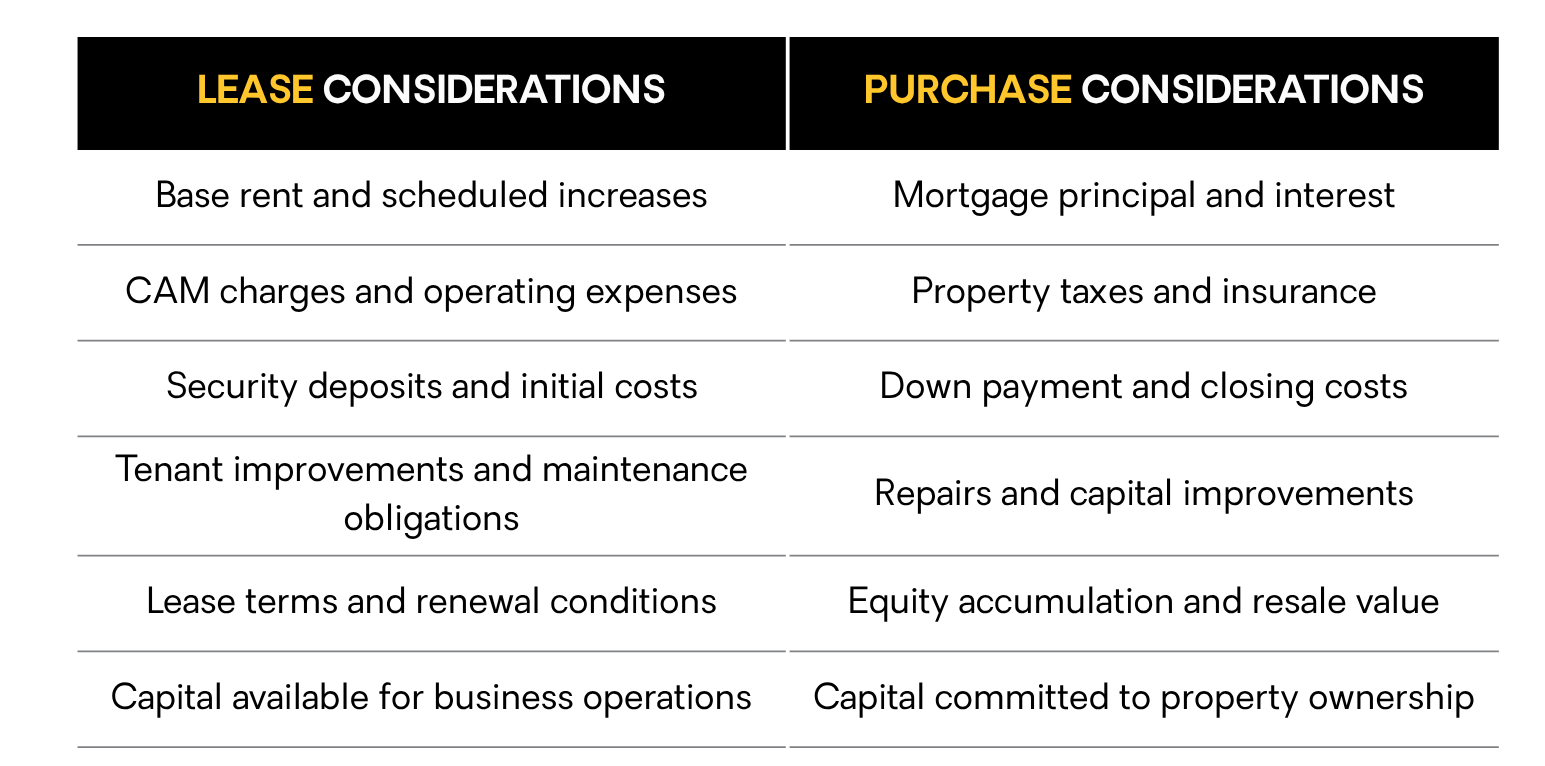
A more thorough lease-versus-purchase analysis can compare projected costs over a five- or ten-year period, accounting for financing terms, rental increases, operating expenses, and potential changes in property value.
This analysis can also evaluate the financial impact of selling the property at the end of the projected holding period, including estimated sale proceeds and remaining loan obligations.
The Importance of Opportunity Cost
One factor that is often overlooked is the opportunity cost of purchasing commercial real estate.
Consider a business with $250,000 available for a property down payment. Purchasing may allow the business to build equity and potentially benefit from appreciation. However, that same $250,000 could alternatively be invested into business expansion, additional employees, equipment, or other opportunities. If those investments are expected to generate a higher risk-adjusted return than property ownership, leasing may be the more financially advantageous decision. On the other hand, a business with stable operations, predictable space requirements, and sufficient available capital may benefit from purchasing.
The decision ultimately comes down to how effectively each option utilizes the business’s available resources.
How Long Do You Plan to Occupy the Property?
Anticipated occupancy is another important consideration.
A business expecting significant growth or relocation within a few years may find leasing more practical, particularly when factoring in acquisition costs and the expenses associated with eventually selling a property.
For an established business planning to remain in the same location for an extended period, ownership may offer greater long-term financial benefits.
However, the anticipated holding period should be evaluated alongside market conditions, financing costs, property appreciation assumptions, and the business’s future space requirements.
A longer holding period does not automatically make purchasing the better option.
Making the Decision Based on the Numbers
There is no universal answer to whether leasing or purchasing commercial real estate makes more financial sense.
Both options can be beneficial depending on the property, business, financing structure, and broader investment objectives.
A comprehensive analysis may consider projected cash flow, total occupancy costs, financing assumptions, potential appreciation, investment returns, and the opportunity cost of capital.
The question isn’t simply whether your business can afford to purchase commercial property. It’s whether purchasing that property is the most effective use of your capital.
Evaluating Your Commercial Real Estate Options
Whether you’re preparing to lease your first commercial space, considering purchasing an owner-occupied building, or evaluating an existing lease, understanding the financial differences can help identify the most practical approach.
Before committing to your next commercial property, let’s evaluate the numbers and determine which option best supports your business’s current needs and long-term objectives.


